

Photographing Prague City Tours During Corporate Incentive Programs: Street
April 12, 2026
Why Prague Incentive Event Photos Need to Work as Sales Material for the Next Year’s Program
April 14, 2026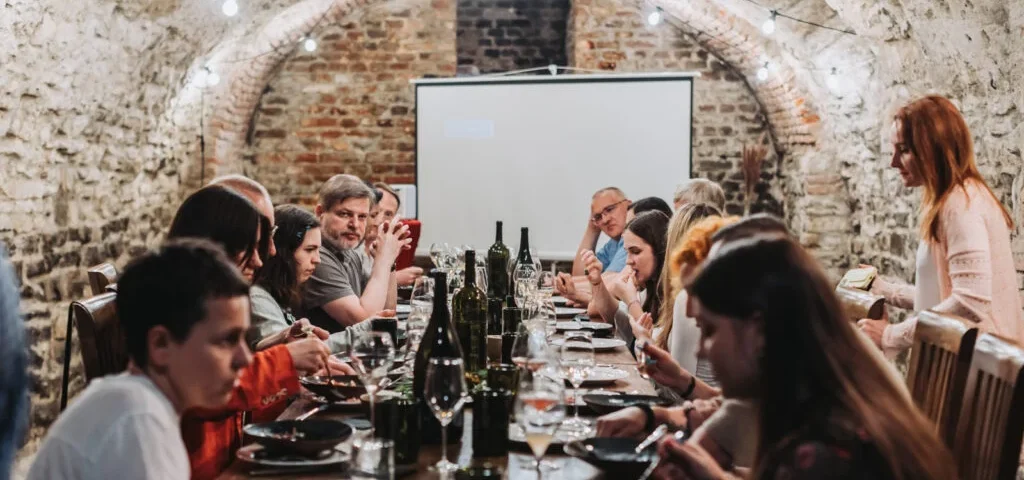
When planning a private dinner in a Prague historic cellar, few details shape the atmosphere as profoundly as lighting. Beneath the cobblestone streets of the Old Town, these centuries-old stone vaults carry an inherent magic — but without thoughtful illumination, even the most breathtaking cellar can feel cold, flat, or simply wrong. Whether you are organizing an intimate wedding dinner, a romantic proposal evening, or an exclusive celebration, understanding how to use cellar lighting in Prague is the difference between a beautiful space and an unforgettable one.
Why Lighting Is Everything in a Historic Prague Cellar
Gothic and Baroque cellars in Prague were built long before electricity. Their architecture — curved stone arches, rough-hewn walls, low ceilings — was designed to interact with candlelight and torchlight. This is not coincidence; it is centuries of design memory. When you honor that memory with the right lighting choices, the room seems to breathe. Every shadow becomes intentional. Every stone surface glows with warmth and texture.
Conversely, bright overhead LED panels or unfiltered fluorescent light strips can strip these spaces of their soul entirely. Lighting in a historic cellar is not decoration — it is the architecture itself.
The Core Lighting Layers for a Cellar Private Dinner
Professional event lighting designers always work in layers. In a cellar environment, these layers must be handled with particular sensitivity to the stonework and the intimate scale of the space.
1. Ambient Lighting: Setting the Foundation
Ambient light establishes the overall mood and visibility level. In a Prague cellar, the goal is warmth without harshness. The recommended color temperature sits between 2200K and 2700K — a deep amber warmth that mimics candlelight. Sources that work beautifully here include:
- Recessed warm spotlights hidden within existing architectural niches
- Wall sconces with dimmable, warm-toned bulbs
- Low-voltage LED strips concealed along ceiling ribs or floor-level moldings
The critical rule: ambient light in a cellar should never be the brightest light in the room. It should make everything gently visible, while other layers do the emotional heavy lifting.
2. Candlelight: The Irreplaceable Core
No artificial lighting system fully replaces real candle flame in a stone cellar. The flicker, the micro-movement of shadows, the slight unpredictability — all of this creates an organic intimacy that LED systems can approximate but never fully achieve. For a private dinner in a Prague cellar, candles should appear in multiple forms:
- Tapered candles in tall silver or brass holders placed along the table centerline
- Votive candles grouped on mirrored trays or in clusters of varying heights
- Pillar candles in wall niches or on stone ledges to extend light into the room’s perimeter
- Floating candles in low glass bowls as part of floral centerpieces
Always confirm with the venue whether open flames are permitted and whether a fire safety officer is required on site. Many Prague historic cellars have specific fire regulations that must be respected.
3. Accent Lighting: Revealing the Stone
One of the most powerful — and most underused — lighting techniques in cellar spaces is upward accent lighting directed at stone walls and vaulted ceilings. A narrow-beam warm spotlight aimed at a rough stone arch creates extraordinary texture and depth. This technique is called grazing, and it works by placing a light source very close to the surface so that the beam runs almost parallel to the wall, catching every ridge and hollow.
Use accent lighting to:
- Highlight original Gothic ribbing on ceilings
- Illuminate a focal wall behind the head table or sweetheart table
- Draw attention to floral arrangements or a champagne display
- Frame the entrance arch so guests enter through a portal of golden light
4. Table Lighting: Where Intimacy Happens
The dinner table itself is the most important zone to get right. Your guests will spend hours here, looking across at each other in the light you have created. Flattering, warm, low light at eye level is the objective. This means keeping lighting sources at or below eye level, rather than above it. Overhead-only lighting creates unflattering shadows on faces — a common mistake even in professional setups.
Best table lighting solutions include:
- Candelabras at varying heights creating layered illumination across the table surface
- Lantern-style centerpieces with real or high-quality flickering LED candles inside
- Slim battery-operated LED table lamps for venues that restrict open flames
Color Temperature: The Numbers That Matter
If you are working with a lighting vendor or specifying fixtures yourself, these color temperature guidelines will help you communicate your vision precisely:
- 1800K – 2200K: Deep amber, firelight quality — ideal for maximum romance, dramatic atmosphere
- 2200K – 2700K: Warm white — the sweet spot for elegant dinners, flattering to skin tones
- 3000K: The upper limit for cellar dinner settings — still warm, but beginning to feel modern
- 4000K and above: Avoid entirely in historic cellar environments — creates a clinical, cold feel
Lighting Challenges Specific to Prague Historic Cellars
Low Ceilings and Restricted Rigging Points
Many Prague cellars have ceiling heights between 2.5 and 3.5 meters. This significantly limits the ability to hang traditional event lighting rigs. Solutions include floor-standing uplighters, wall-mounted fixtures, and creative use of existing iron hooks or architectural protrusions that are already part of the historical structure.
Stone Surfaces and Light Absorption
Dark, aged stone absorbs a considerable amount of light. What appears bright in a showroom will often feel dim when deployed against centuries-old masonry. Always test your lighting setup during a venue visit before the event. Plan for 30–40% more light sources than you think you need.
Limited Power Infrastructure
Historic buildings in Prague’s Old Town often have older electrical systems with limited socket placement and amperage availability. Discuss power requirements with the venue well in advance and consider battery-operated or rechargeable lighting options as a flexible supplement.
Working With Flowers and Table Design Under Cellar Lighting
Lighting and floristry in a cellar must be designed together, not separately. Warm amber light dramatically shifts the appearance of flower colors. Pure whites will take on a golden hue. Cool purples and blues may appear muted or almost brown. Colors that perform beautifully under cellar candlelight include:
- Deep burgundy, oxblood red, and wine tones
- Burnt orange, copper, and terracotta
- Ivory and champagne rather than pure white
- Dusty rose and blush in larger, fuller arrangements
Greenery — particularly dark eucalyptus and deep-toned foliage — appears exceptionally lush and rich under warm amber light. It is one of the most elegant pairings possible in this environment.
Photography Considerations: Lighting Your Cellar Dinner for the Camera
Your photos and videos will be your lasting memory of this evening. Candlelight and warm ambient light are notoriously challenging for cameras, especially in the low-light conditions of a cellar. To support beautiful photography without compromising the atmosphere for your guests:
- Ensure there is a slightly higher base level of ambient light than you think you need — photographers can always darken an image in editing, but cannot recover detail lost to pure darkness
- Place candles and light sources consistently across the table rather than in isolated clusters
- Avoid mixing color temperatures (warm candles beside cool LED strips, for example) — this creates mixed-color shadows that are very difficult to correct in post-processing
- Discuss your lighting plan with your photographer before the event — an experienced cellar photographer will have specific requests
Frequently Asked Questions
Q1: Can we use real candles in Prague historic cellars, or are there restrictions?
This varies by venue. Many of Prague’s most prestigious historic cellars — particularly those in protected landmark buildings — do permit real candles but require them to be in enclosed holders, placed at a safe distance from any decorative fabrics, and sometimes require a fire warden or safety protocol to be in place. Always confirm the specific fire regulations with your venue coordinator well in advance of the event. Some venues may require a security deposit related to fire safety. High-quality flickering LED candles have improved dramatically in recent years and are a viable alternative when open flames are not permitted.
Q2: How many light sources do we typically need for an intimate cellar dinner of 10–20 people?
For a table seating 10 to 20 guests in a standard Prague cellar section, a well-balanced setup typically includes: 4 to 6 wall-mounted or floor-standing uplighters around the perimeter, 2 to 3 accent spotlights highlighting architectural features, and a minimum of 15 to 25 individual candle flame points distributed across the table and room periphery. This is a starting guideline — the specific dimensions, ceiling height, and stone color of your chosen cellar will all affect the final number. Always conduct a lighting test on-site before the event evening.
Q3: Should we hire a professional lighting designer for a cellar private dinner, or is the standard venue lighting sufficient?
Standard venue lighting is almost never sufficient for a truly memorable private dinner experience. Most historic cellar venues offer a basic setup — general ambient light to ensure visibility and safety. A professional lighting designer or an event production team with cellar experience will transform that baseline into a fully immersive atmosphere. For intimate dinners of 8 to 30 guests in a historic Prague setting, even a modest lighting enhancement package — uplighters, table candles, and one or two focused accent spots — makes an extraordinary difference to the overall experience. The investment is consistently one of the highest-impact elements per euro spent in cellar event design.
ProEventPrague.com’s Founders Tips by Kemal Onur Ozman
From the lens of an experienced event and conference photographer who has worked across Prague’s most iconic historic cellars, here is the insight I wish more couples and planners knew before their event:
The single most common lighting mistake I see in Prague cellar dinners — even at otherwise beautifully designed events — is what I call “the forgotten transition zone.” Everyone focuses on lighting the table perfectly, and everyone remembers the accent lights on the stone arches. But nobody lights the space between those two zones: the middle height of the room, roughly from 80cm to 180cm off the floor, which is exactly where human faces exist during a seated dinner.
Here is my professional tip: place at least two or three light sources — ideally candles or small lanterns — on secondary surfaces at 60 to 80cm height around the edges of the room. Sideboards, stone window ledges, small pedestals, even the floor next to a wall. These create a fill light at face level from the sides, softening shadows and making every person at the table look extraordinary in photographs. The effect is exactly what great portrait photographers call “Rembrandt lighting” — and it happens naturally in a well-candled cellar when you think in three dimensions rather than just “table” and “ceiling.”
For photography specifically: I always ask couples to allow me to arrive 45 minutes before guests. I walk the space while it is fully lit and empty, take test exposures, and identify the two or three positions where the light is simply perfect. Those become my anchor points for the evening. When the magical moments happen — the first clink of glasses, a quiet laugh between the couple, a grandparent watching with tears — I am already positioned where the light will tell the story most beautifully.
Plan your light. Then let it become invisible. That is when it starts doing its real work.
— Kemal Onur Ozman, Co-Founder, ProEventPrague.com