
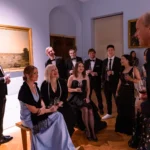
The Cocktail Hour Is Your Best Hour: Why Prague Gala Photographers Prioritize the First 60 Minutes
August 5, 2026
The Table Detail Shot: Why Prague’s Corporate Clients Judge You by This One Image
August 7, 2026
Shooting black tie events in Prague without flash is one of the most technically demanding disciplines in event photography — and one of the most rewarding. The candlelit ballrooms of the Žofín Palace, the amber-lit corridors of the Municipal House, the grand salons of Prague’s historic venues pulse with a quality of light that no artificial strobe can replicate. But capturing that magic without flash and without compromise requires more than expensive gear. It demands intimacy, patience, and a deep technical fluency with available light. Whether you’re a photographer preparing for your first Prague black tie assignment or a couple seeking to understand what truly separates extraordinary event photography from the ordinary, this guide walks you through every layer of the craft.
Why No Flash? Understanding the Philosophy Behind Available Light Photography
Before we talk lenses and ISO settings, we need to understand why. Flash at black tie events does more than create harsh shadows — it disrupts the atmosphere. It pulls guests out of the moment. It flattens the architectural grandeur of Prague’s baroque interiors into a bleached, two-dimensional record. The philosophy of no-flash event photography is not a limitation. It is a commitment to authenticity.
Prague’s finest venues were designed by architects who understood light as an emotional force. When you photograph inside the Lobkowicz Palace or the Grand Hotel Bohemia Ballroom, you are working inside a masterpiece. Flash photography inside such spaces is, in a very real sense, an act of artistic disrespect — and your images will show it.
Gear Selection: Building Your Low-Light Arsenal for Prague Black Tie Events
Camera Bodies: Prioritize High ISO Performance
The foundation of no-flash black tie photography is a camera body that handles high ISO gracefully. The difference between a camera that renders ISO 6400 as painterly grain and one that renders it as digital mud is everything.
Recommended bodies as of 2025–2026 include:
- Sony A7S III — Still the king of high-ISO event work. At ISO 12,800, images remain remarkably clean.
- Nikon Z8 / Z9 — Exceptional dynamic range and color science that handles warm tungsten light beautifully.
- Canon EOS R5 Mark II — Improved high-ISO performance and stellar autofocus for fast-moving event situations.
- Fujifilm GFX 100S II — For the photographer who wants medium format presence in a low-light formal setting, the film simulations handle candlelight with extraordinary elegance.
Shoot RAW always. No exceptions. Prague’s layered tungsten, LED, and candlelight environments demand maximum latitude in post-processing.
Lenses: The Fast Prime Philosophy
Your lens selection is your single most important decision when shooting black tie events in Prague without flash. Zoom lenses, however excellent, rarely match the light-gathering capability and rendering quality of fast primes at formal events.
- 85mm f/1.4 — The classic black tie lens. Gorgeous compression, beautiful subject separation, naturally flattering for formal portraits in hallways and staircases.
- 50mm f/1.2 — Versatile, natural perspective. Exceptional for table scenes, speech moments, and environmental portraits that show the venue.
- 35mm f/1.4 — For tighter ballroom spaces where you need context. Prague’s older venues often have intimate rooms where compression isn’t your friend.
- 135mm f/1.8 — Exceptional for capturing candid emotional moments from across the room without disturbing the scene. A lens that truly disappears.
The rule: never shoot a Prague black tie event with a maximum aperture wider than f/2.8. If it’s f/2.8, you will need perfect stabilization and ideal ambient conditions. f/1.4 or f/1.8 gives you the freedom to work with confidence.
Stabilization and Support
In-body image stabilization (IBIS) combined with optical stabilization in the lens is your silent assistant. At shutter speeds of 1/60s on an 85mm lens — which may be required in the darkest corners of a Prague palace — IBIS is not a luxury. It is a necessity.
Reading the Light in Prague’s Black Tie Venues
Every photographer who works regularly in Prague’s historic event spaces will tell you the same thing: you must arrive early and read the room. Not glance at it. Read it.
The Pre-Event Walk-Through
Arrive at least 45 minutes before guests. Walk the entire venue. Look for:
- Key light sources — Where are the chandeliers? Where are the candelabras positioned? Where does the window light fall during the cocktail hour?
- Dead zones — Areas of near-complete darkness where no flattering available light exists. Know these zones so you can guide subjects away from them or avoid staging shots there.
- Golden pockets — The spots where two or three warm light sources overlap, creating a soft, directional glow. These are your natural portrait studios.
- Background depth — In a baroque ballroom, a well-chosen background 10 meters behind your subject at f/1.4 renders into a glorious blur of gold and amber. Identify these compositions in advance.
Understanding Prague’s Characteristic Light Palette
Prague’s formal venue interiors typically present a complex mixture of color temperatures. You will encounter warm tungsten (2700–3200K) from chandeliers, neutral white LED uplighting (4000–5000K) from modern additions, and the organic flicker of candlelight sitting around 1800K. This creates intentional color temperature tension that, when embraced rather than corrected, produces the richly layered look that makes Prague black tie photography distinctive.
In post-processing, resist the urge to globally neutralize color temperature. Instead, use selective color grading to preserve the warmth of candlelit zones while managing cooler areas separately. The contrast between warm foreground and cool middle-ground depth is part of the visual story.
Camera Settings: A Practical Framework for No-Flash Black Tie Photography
Exposure Triangle in Formal Event Conditions
There is no single “correct” setting for black tie event work because lighting conditions shift dramatically throughout the evening. However, a practical starting framework for Prague’s formal venues is:
- ISO: Begin at ISO 3200 during cocktail hour. Be prepared to push to ISO 6400 or ISO 12800 during dinner service and dancing when ambient light is reduced.
- Aperture: f/1.4 to f/1.8 for portraits and candids. Stop down to f/2.8 to f/4 for group shots where depth of field is critical.
- Shutter Speed: Minimum 1/100s for stationary subjects. 1/250s or faster for any movement — dancing, gestures, laughter. Never compromise on minimum shutter speed to gain exposure; it is better to push ISO than to lose sharpness to motion blur.
Autofocus Strategy in Low-Light Black Tie Conditions
Modern mirrorless systems have transformed low-light autofocus, but they still require intelligent configuration. For black tie event work:
- Enable eye-detection AF as your primary mode for portrait moments. It remains reliable even at ISO 12800 on current Sony, Canon, and Nikon bodies.
- Switch to wide-area AF with subject tracking for dance floor and speech moments where subjects move unpredictably.
- Use single-point AF for intentionally composed static shots — staircases, entrance moments, formal couple portraits.
- Assign AF sensitivity to a custom button. When you’re tracking a speaker through a dimly lit ballroom, you need instant access to AF behavior adjustments.
Compositional Techniques for Black Tie Events in Prague
Architecture as Frame and Character
Prague’s black tie venues are themselves protagonists in your photographs. The arched doorways of the Strahov Monastery Library, the gilded columns of the Estates Theatre, the wrought iron balustrades of the Žofín — these elements are not backdrops. They are part of the story. Use them actively:
- Frame subjects through doorways and arches to add depth and context.
- Use reflective marble floors for low-angle compositions that double the light and grandeur.
- Incorporate staircases for natural layering — guests at multiple levels create compositional richness unavailable in flat ballroom shots.
The Decisive Micro-Moment
At black tie events, the moments that matter are rarely the planned ones. They are the micro-expressions — the half-smile during a toast, the whispered conversation between two guests, the brief touch of a hand on a shoulder. These require you to be perpetually present, shooting continuously with your eye trained not on what is happening but on what is about to happen.
Use burst mode judiciously. At 10–20 frames per second, you can capture the precise peak of an expression that lasts 200 milliseconds. But be selective in editing — present only the single definitive frame from each sequence. The curator’s eye is as important as the photographer’s instinct.
Working with Silhouettes and Shadow
No-flash photography in Prague’s ornate interiors enables a technique that flash work destroys entirely: the intentional silhouette. When a guest stands before a backlit window at dusk, or a couple pauses at the threshold of a lit ballroom, the silhouette communicates elegance, mystery, and romance in a single frame. Expose for the background. Let the foreground go dark. Trust the image.
Post-Processing: Preserving the Prague Night Atmosphere
Noise Management Without Clinical Over-Processing
High ISO grain at formal events is not a problem to be eliminated. It is a textural characteristic that, when managed well, adds atmosphere. The mistake most photographers make is applying maximum noise reduction and stripping the image of all grain, leaving a plasticky, unnatural result.
Use Adobe Lightroom’s AI Denoise or DxO PureRAW 4 at 60–75% strength. Preserve luminance detail. Accept some grain in shadow areas — this is where the image lives and breathes. Apply selective sharpening to eyes and key focal points rather than global sharpening that amplifies noise in smooth areas.
Color Grading for Black Tie Elegance
The tonal palette of a black tie event should feel like it belongs in the room. For Prague’s warm-interior aesthetic:
- Lift shadows with a subtle orange or amber tint to preserve the warmth of the venue lighting.
- Cool the highlights slightly — deep blue or teal in the brightest areas creates a sophisticated tension against warm midtones.
- Use the HSL panel to protect skin tones from orange oversaturation while still maintaining the warmth of the overall palette.
- Deep, rich blacks with preserved detail. Crushed blacks remove shadow information and lose the depth that makes black tie photography distinctive.
Ethical and Professional Conduct at Black Tie Events
Shooting without flash is as much an act of professional respect as it is a technical choice. At black tie events, you are a guest with a camera, not a photographer who happens to be present. This distinction matters:
- Move silently. No running shoes on marble floors. No rapid repositioning that disturbs table service or conversations.
- Request, don’t demand. When you need a subject to pause or reposition, ask with quiet authority rather than directing loudly.
- Know when not to shoot. Some moments — a guest in distress, a private exchange, a child sleeping — are not yours to capture.
- Dress the part. You are working a black tie event. You should be dressed at or near black tie standard. Your appearance communicates your professionalism before you lift the camera.
Frequently Asked Questions
What is the most challenging aspect of shooting black tie events in Prague without flash?
The greatest challenge is maintaining consistent exposure quality as lighting conditions shift throughout the evening. Prague’s historic venues often have dramatically different lighting zones — a brilliantly lit entrance hall, a dimly candlelit dining room, a darkened dance floor with spotlights. There is no single setting that works across all environments. The most experienced photographers develop an almost instinctive rhythm of adjusting ISO, aperture, and shutter speed as they move through the space, reading each new environment in seconds. This fluency only comes from extensive shooting in similar venues — and from the discipline of reviewing your histogram constantly rather than relying on the camera’s LCD preview, which can